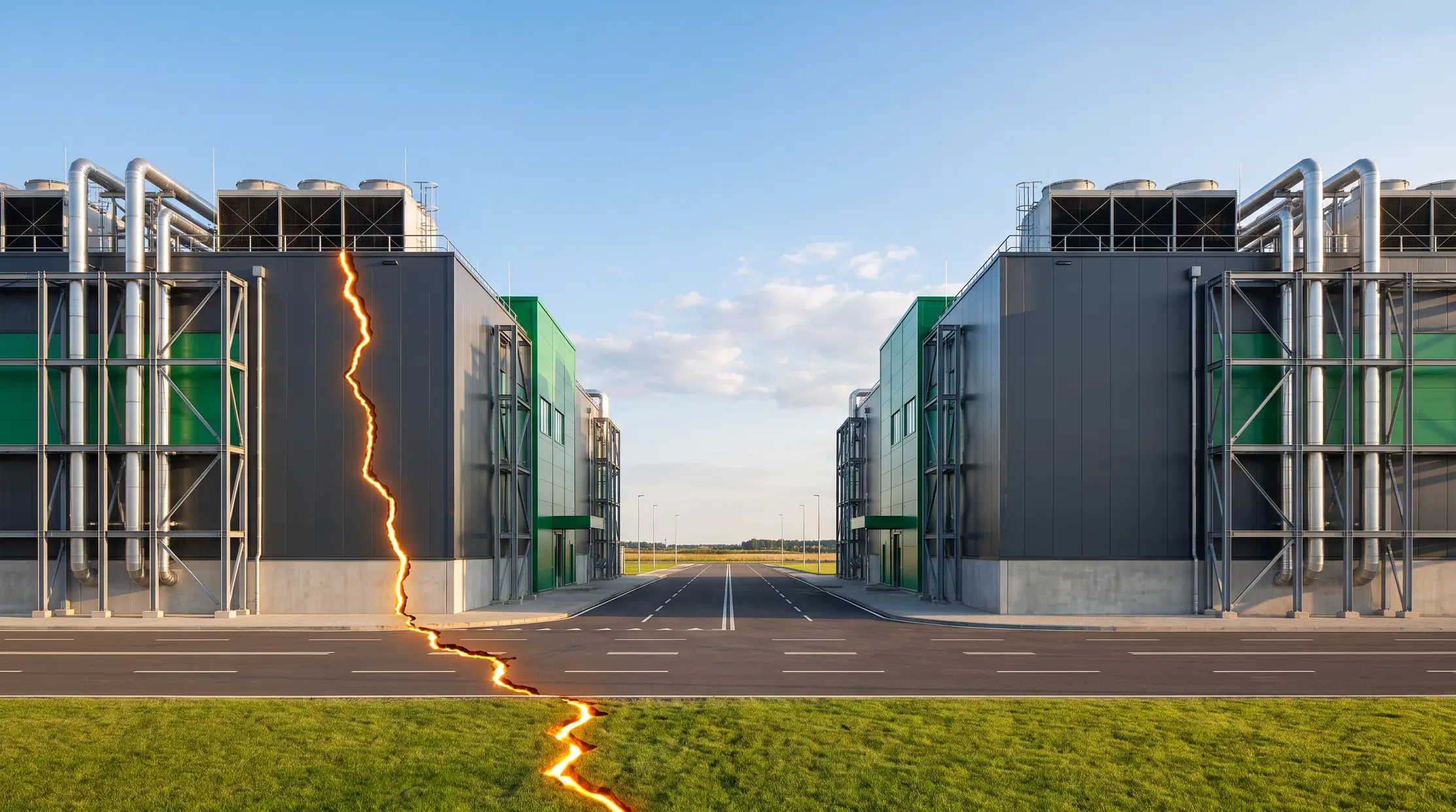
Strain builds quietly inside a facility, long before anything visibly fails.
See the strain before it becomes downtime, and show it to everyone who's asking.
Most facilities don't fail all at once. They compensate quietly: extra cooling hours, deferred maintenance, staff covering gaps. Vulnerability Under Load™ (VUL™) Mapping finds that compensation across nine systems while it can still be fixed. It shows what to fix first and measures the change. You and your community receive the same red, yellow or green status.
Ask yourself:
If your strongest system failed tomorrow, which workaround would you discover first?
If you're not sure, keep reading.
Public official? See what mapping means for your citizens →
Request a conversationWhat each color means for your facility.
- Red: strain has crossed into active risk of failure, downtime or damage. Act now.
- Yellow: strain is building. Address it now, while it is still inexpensive to correct. Left alone, it moves to red.
- Green: conditions mapped and found within sustainable limits at the time of mapping.
The status is a symbol. TALUS-2 performs the mapping and delivers the status to every party.
Everything looks fine, until it doesn't.
You're expected to grow capacity, cut cost and keep uptime perfect. Now officials, communities, lenders and insurers all want proof, and your own reports aren't enough for them.
When it takes more effort to keep the same output, a facility isn't growing stronger. It's compensating, and compensation hides strain until it runs out.
TALUS-2 gives you an independent, whole-system status every quarter. It finds strain while it can still be corrected, and shows it to everyone who's asking.
Your five priorities, and how TALUS-2 answers them.
1. Meeting officials' requirements, so you can build and expand.
TALUS-2: an independent status officials can rely on, because they receive the same finding you do. Planning a new facility? It gives your application an independent finding, not only your own studies. It supports the approval process; it does not replace it.
2. Finding strain before it becomes breakdown.
TALUS-2: we find where strain is building across all nine systems while it can still be fixed, because real risk lives in how the systems affect each other.
3. Increasing efficiency.
TALUS-2: we map the compensation that wastes money: cooling running longer, repairs made only after something breaks, new capacity that sits unused. Then we show what to fix first, so spending goes where it returns the most.
4. Being safe for the environment.
TALUS-2: each quarter we map the sources communities worry about: emissions from backup generators, water draw and discharge, noise at the property line, and the chemicals and batteries stored on site.
5. Staying profitable.
TALUS-2: running efficiently without breakdown is profitability. If you're red, you receive a list of what to fix first. Each quarter's re-mapping shows whether the strain came down, and as your status moves to green, everyone who receives it sees the progress. That independent record of strain found and fixed also lowers your liability and gives lenders and insurers the proof they ask for.
Nine systems, mapped as one.
- Electrical Power: less spare power from the grid, while AI computers swing their power use faster than most backup plans expect.
- Cooling and Thermal: cooling sized for the original design, not for this summer's heat.
- Water: a supply interruption or drought restriction can stop cooling outright.
- Hardware and IT: paying for capacity you don't use, or running equipment past its safe life.
- Structural and Physical: an older building carrying more weight than it was built for.
- Personnel and Maintenance: skipped steps and too few people on call, among the fastest-growing causes of outages.
- Chemical and Hazardous Materials: cooling chemicals, fire-fighting agents and batteries that can cause fires, disposal problems and new rules.
- Network and Connectivity: outages caused by internet providers and setup mistakes that a power or cooling check never catches.
- Cybersecurity: hackers getting in where computer networks meet the controls for power and cooling.
VUL™ sits beside your engineering, compliance and insurance reviews. It does not replace them.
Why your current reviews miss it.
Your risk is reviewed in pieces: engineers check power and cooling, consultants handle permits, insurers protect their own risk. Each does one piece well. None looks at the whole system, and real risk lives in how the systems affect each other. VUL™ maps all nine systems as one, beside those reviews, not instead of them.
Why TALUS-2 is different.
- Independent: paid the same whatever the result, and the same status to every party.
- The whole system, every quarter: not one discipline at one moment.
- Your data stays yours: protected under the signed agreement.
- A published framework: Vulnerability Under Load™ is a patent-pending framework created by Aurelio Pete Jimenez, DPM, founder of TALUS-2. It is set out in the book Vulnerability Under Load and its guides. The way a status is decided remains proprietary to TALUS-2.
- Integrity first: a live conversation before any mapping, no pressure, and a limit of two sites every 60 days.
How it works.
- A free live conversation to see whether mapping fits an active or upcoming risk review.
- A signed agreement covering scope and confidentiality, with the first quarterly cycle paid at signing.
- The mapping, carried out by TALUS-2.
- Your status and a list of what to fix first, followed by re-mapping every quarter that measures the change.
Questions operators ask.
Is this an inspection or a government approval?No. VUL™ Mapping is an independent strain map that works alongside your own reviews.
What does it cost?Each quarterly mapping cycle is priced in the scoping conversation, before anything is signed, and is paid at the start of the cycle.
Who owns our data and results?You do, under the signed agreement. If public officials also receive your status, they receive the same status you do.
Back to your answer.
Which workaround would you discover first?
With TALUS-2, you find it while it can still be fixed, and when officials, lenders or your board ask for proof, you have it. Request a conversation below.
Not ready yet? Start with the framework: the Executive Checklist, $19.99, or the complete Knowledge System, $399.